Table of Contents
- Start With What Your Dog Can Still Do
- Pet Stairs: Best for Partial Height Gaps
- Ramps: Best for Dogs Who’ve Lost the Ability to Climb
- Choosing Between Them: A Practical Checklist
- Support Harnesses and Slings: For In-Between Moments
- When to Combine Approaches
- Introducing Any New Aid
- The Bottom Line
- When a Ramp Is the Better Choice
- When Stairs Make More Sense
- Sizing and Safety Features to Look For
- Full-Body Lifting Harnesses and Slings
How PawSeniors Researches This
PawSeniors articles are written and edited in-house, then checked against primary veterinary sources before publishing.
- Every medical claim is sourced to the American Kennel Club, PetMD, VCA Animal Hospitals, or another named veterinary source, linked at the end of the article.
- We don’t publish AI-generated or unverified health claims, and we don’t accept sponsorship in exchange for editorial content.
- Articles are updated when veterinary guidance changes.
Owners often reach for whichever mobility aid shows up first in a search — usually a ramp — without checking whether it actually matches their dog’s specific level of decline. A dog who still jumps confidently but struggles with one particular height needs something different from a dog who can no longer manage stairs at all. Matching the aid to the actual problem saves money and, more importantly, gets used instead of gathering dust because the dog never adapted to it.
Start With What Your Dog Can Still Do
Before buying anything, watch specifically for what your dog avoids versus what they still attempt. A dog who still jumps onto the couch but hesitates before car entry has a different problem than a dog who’s stopped attempting stairs entirely. That distinction should drive the purchase, not a generic “senior dog” product category.
Pet Stairs: Best for Partial Height Gaps
If your senior dog still has reasonably good balance and general agility, but struggles specifically with the height of a bed or couch, a set of pet stairs is often the better fit. Stairs occupy less floor space than a ramp, which matters if something needs to sit pushed up against furniture permanently — a ramp’s length makes it far harder to tuck against a bed in a bedroom. The tradeoff is that stairs still require a degree of coordinated leg lift at each step, which is exactly what a dog with more significant joint pain or weakness struggles with.
Ramps: Best for Dogs Who’ve Lost the Ability to Climb
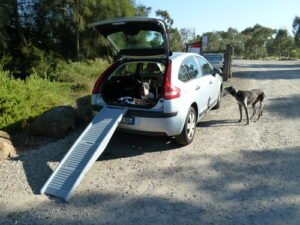
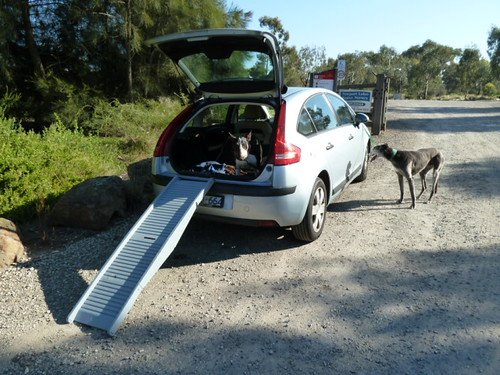
For dogs that can no longer manage stairs at all, or who need help getting into or out of a car, a ramp is the safer option — it replaces the stepping motion with a continuous incline that doesn’t require the same joint flexion. The advantage of a ramp is that you can start at a low, gentle angle and increase it gradually as your dog builds confidence, rather than being locked into a fixed step height from day one. Ramps also tend to be lighter and easier to fold than quality stairs, which matters if you want one that travels with you for car access specifically.
The catch is surface and stability: look for a gentle slope and a non-slip surface, and make sure the ramp itself is sturdy and doesn’t shift or slip underfoot — a wobbly or slick ramp will simply get refused, no matter how appropriate it is in theory. A too-steep ramp is arguably worse than no ramp at all for a dog with joint pain, since it demands more braking effort on the way down than a set of shallow steps would.
Choosing Between Them: A Practical Checklist
- Can your dog still climb stairs, just not jump? Pet stairs, matched to a comfortable step height for your dog’s size.
- Has your dog stopped attempting stairs entirely, or do they need car access? A ramp, starting at a low angle.
- Is floor space tight, or does the aid need to stay permanently against furniture? Stairs, for their smaller footprint.
- Does the aid need to travel (car trips, visits)? A folding ramp, for portability.
- Is your dog anxious about new equipment? Either option benefits from a slow introduction — treats and encouragement at the base, letting the dog approach on their own terms rather than being placed on it.
Support Harnesses and Slings: For In-Between Moments
Neither stairs nor ramps solve every transition. A rear-support harness or sling — a handle positioned over the hips — helps a dog with significant hind-leg weakness navigate a single unavoidable step, get up from a slippery floor, or manage a short outdoor walk without the owner needing to lift the dog’s full weight. These are especially useful for larger dogs where full-body lifting isn’t practical for the owner, and they bridge situations where a fixed ramp or stairs simply aren’t present, like an unfamiliar location.
When to Combine Approaches
Most households with a significantly mobility-limited senior dog end up using more than one aid: stairs by the bed, a ramp for the car, and a harness for outdoor walks or vet visits. That’s normal and expected — different transitions have different demands, and a single product rarely covers all of them. Start with whichever gap is causing the most daily friction (often the couch, bed, or car), and add others as specific needs become clear.
Introducing Any New Aid
Regardless of which aid you choose, dogs generally need a gradual, positive introduction rather than being placed on unfamiliar equipment cold. Let your dog sniff and investigate first, use treats to build a positive association, and don’t force use on the first attempt — a dog that has one bad, scary experience with a wobbly ramp may refuse it entirely afterward, even once you’ve fixed the stability problem.
The Bottom Line
The right mobility aid depends on exactly what your dog can and can’t do anymore, not a generic “senior dog” purchase. Watch what they avoid, match the aid to that specific gap, and introduce it slowly — a well-matched, properly introduced aid gets used daily; a mismatched or poorly introduced one becomes expensive clutter.
When a Ramp Is the Better Choice
Ramps generally suit senior dogs best because a gentle, consistent incline distributes effort evenly across all four legs, rather than asking a dog to repeatedly flex and extend sore joints the way climbing steps does. This makes ramps the safer default for dogs with arthritis, hip dysplasia, recent surgery, or any condition where joint-loading is a concern. Ramps are also usually lighter and easier to fold flat than stairs of comparable size, which makes them more practical for car access, a place where stairs are rarely a realistic option at all, as well as for owners who need to move the ramp between rooms or store it out of the way.
The tradeoff is floor space and angle: a ramp needs enough length to keep the incline gentle, which means a ramp reaching a tall bed or a raised SUV trunk will take up considerably more floor room than a set of stairs reaching the same height. Adjustable or telescoping ramps help here, letting the incline be shortened for lower surfaces and extended for taller ones.
When Stairs Make More Sense
Pet stairs take up less floor space than a ramp reaching the same height, which makes them the more practical option for permanent use at a couch or bed pushed against a wall. They can also work well for dogs with only mild mobility issues, provided the steps themselves are wide, shallow, with a low rise per step, and finished with a non-slip surface, since steep, narrow, or slick steps can actually be harder on an arthritic dog than no aid at all, as they still require repeated joint flexion, just in smaller increments.
Stairs tend to suit dogs who are already fairly steady on their feet and simply need a bit of height assistance, more than dogs with significant hind-end weakness or balance problems, where the flexion and balance demands of stepping can outweigh the benefit.
Sizing and Safety Features to Look For
Whichever option you choose, a few features matter more than brand or price. Width should comfortably fit your dog’s whole body, not just their front feet, since a narrow ramp or step invites a dog to place paws unevenly and lose balance. A non-slip surface, whether textured rubber, carpet, or a grip coating, is non-negotiable for a dog with any joint weakness, and weight capacity should be checked against your dog’s actual weight with margin, not their weight at a healthier point in life. For ramps specifically, side rails or raised edges help prevent a dog from stepping off the side mid-climb, which is one of the more common causes of ramp-related falls.
Full-Body Lifting Harnesses and Slings
For dogs whose mobility has declined further, such as significant hind-end weakness, post-surgical recovery, or advanced arthritis, a ramp or stairs may not be enough on their own, and a supportive harness or sling becomes a useful complement rather than a replacement. These harnesses, worn around the torso or hindquarters, let an owner provide physical support during stairs, getting into a car, or simply standing up from a lying position, without having to lift a dog’s full body weight unassisted. They’re generally used alongside, not instead of, a vet-guided mobility plan, since the underlying cause of the weakness still needs its own diagnosis and treatment.
Sources: American Kennel Club — Dog Stairs vs. Ramps: Choosing the Right Option, VCA Animal Hospitals — Creating a Comfortable Home for Your Mobility Compromised Dog.
Photo: "dogs and car and ramp" by annieb, licensed under CC BY-SA 2.0. Source.