Table of Contents
How PawSeniors Researches This
PawSeniors articles are written and edited in-house, then checked against primary veterinary sources before publishing.
- Every medical claim is sourced to the American Kennel Club, PetMD, VCA Animal Hospitals, or another named veterinary source, linked at the end of the article.
- Every claim is tied to a named, checkable veterinary source linked at the end of the article — nothing is published without a reference you can verify yourself.
- Articles are updated when veterinary guidance changes.
A dog that handled being alone just fine for years can start struggling with it in their senior years, and it’s easy to misread as a training lapse. According to the American Kennel Club, older dogs are more likely to develop separation anxiety because they’re less able to cope with changes in their surroundings — and in many cases, the anxiety is a symptom of something physiological, not a behavior problem to retrain away.
The Cognitive Connection
Cognitive dysfunction syndrome (CDS) is a common driver of new-onset separation anxiety in older dogs. As memory, learning, perception, and awareness decline — in ways that resemble early-stage Alzheimer’s in humans — a dog can lose the learned understanding that being alone is safe and temporary. That confusion, not defiance or poor training, is often what’s behind the sudden panic.
This isn’t rare: in one cited study, 28% of owners of dogs aged 11 to 12 reported at least one sign of cognitive decline, rising to 68% of owners of dogs aged 15 to 16.
How This Differs From Typical Separation Anxiety
Classic separation anxiety, the kind seen in younger dogs, usually has an identifiable trigger: a change in schedule, a move, a new pet, or a history of shelter life. Anxiety tied to cognitive decline in a senior dog often has no clear trigger at all — a routine that’s been stable for years suddenly stops working, which is itself a clue. Standard separation-anxiety training techniques, like gradual desensitization to departure cues, tend to work more slowly or less completely when cognitive decline is the underlying driver, since the dog isn’t just anxious about being alone, it may be struggling to hold onto the memory that alone-time reliably ends.
Signs Worth Connecting to Each Other
Separation anxiety in a senior dog rarely shows up alone. Watch for it alongside:
- House soiling, even in a previously reliable dog
- New phobias that weren’t there before
- Disrupted sleep or waking at night
- Excessive vocalization, including barking at nothing in particular
- General disorientation
Seeing separation anxiety alongside two or more of these is a stronger signal that cognitive decline is involved, rather than a one-off bad day or a change in routine.
What Helps
Because the underlying cause matters, management differs from typical separation-anxiety training advice:
- Get a vet exam first. A sudden onset of anxiety-related behavior deserves a checkup, both to evaluate for CDS and to rule out pain or other treatable causes.
- Keep routines predictable. Consistent departure and return times, and a stable environment, reduce the disorientation that fuels anxiety.
- Consider environmental and mental enrichment. Puzzle toys, scent games, and short training sessions support cognitive function and can reduce anxious idle time.
- Ask about medication or supplements. For diagnosed CDS, vets may discuss options that support cognitive function alongside anxiety management.
What a Vet Visit for This Actually Involves
Diagnosing cognitive decline as the cause typically starts with ruling out physical pain, thyroid issues, and vision or hearing loss through a standard exam and bloodwork, since any of these can independently cause new anxiety-like behavior. If those come back clear, a vet may use a structured questionnaire scoring changes across memory, awareness, and behavior to formally assess the likelihood of CDS, which is more reliable than judging from the anxiety symptom alone.
The Bottom Line
A sudden change in how your senior dog handles being alone is information, not just an inconvenience. Treating it as a vet-visit trigger — rather than a training failure — leads to a more accurate diagnosis and a plan that actually addresses the cause.
Sources: American Kennel Club — Can Senior Dogs Get Alzheimer’s?, VCA Animal Hospitals — Nutrition for Dogs With Cognitive Dysfunction Syndrome.
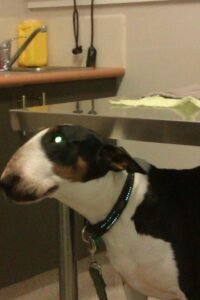
Photo: “Waiting up” by monkeywing, licensed under CC BY 2.0.