Table of Contents
How PawSeniors Researches This
PawSeniors articles are written and edited in-house, then checked against primary veterinary sources before publishing.
- Every medical claim is sourced to the American Kennel Club, PetMD, VCA Animal Hospitals, or another named veterinary source, linked at the end of the article.
- Every claim is tied to a named, checkable veterinary source linked at the end of the article — nothing is published without a reference you can verify yourself.
- Articles are updated when veterinary guidance changes.
A senior dog who stops responding to their name, sleeps through the doorbell, or gets startled awake instead of hearing you approach isn’t necessarily being stubborn or losing interest. Hearing loss is one of the most common, and most easily missed, age-related changes in senior dogs.
Presbycusis: The Age-Related Kind
The most common form of hearing loss in senior dogs is presbycusis, gradual, age-related hearing decline that typically develops during the last third of a dog’s expected lifespan and worsens slowly over time. Because it develops gradually rather than all at once, it’s often missed for months, with owners attributing early signs to inattentiveness or general aging rather than hearing specifically.
What Owners Actually Notice First
Hearing loss rarely announces itself clearly. Early signs tend to be subtle: not responding to their name from another room, sleeping through sounds that used to wake them instantly, not reacting to other dogs barking or to the doorbell, and seeming startled rather than alert when you enter a room they didn’t hear you approach. Higher-pitched sounds, like a whistle or a squeaky toy, are usually lost first, with lower and mid-range sounds following as hearing loss progresses.
Confirming It’s Actually Hearing Loss
Because the early signs overlap with normal aging and even early cognitive decline, it’s worth having a vet examine your dog’s ears to rule out treatable causes like infection, wax buildup, or a foreign object before assuming it’s permanent age-related loss. For a more definitive answer, vets can perform a BAER test (brainstem auditory evoked response), which measures the brain’s electrical response to sound and can confirm the degree of hearing loss in each ear.
Adjusting Life With a Hard-of-Hearing Dog
Once hearing loss is confirmed, most of the practical adjustments are about safety and communication rather than treatment, since age-related hearing loss generally isn’t reversible. Hand signals can replace or supplement verbal commands for dogs who already know basic cues, and many owners find their dog picks these up faster than expected since dogs already read body language closely. A stomp on the floor, since dogs can often feel vibration even when they can’t hear, or a flashlight signal in low light are common ways to get a hard-of-hearing dog’s attention from a distance.
Safety becomes a bigger consideration too: a dog who can’t hear an approaching car or a warning bark from another dog needs closer supervision outdoors, and off-leash areas that were safe before may no longer be, regardless of how well-trained the dog is.
Waking a Dog Who Can’t Hear You
Waking a sleeping dog who can’t hear you approach deserves extra care, since being startled awake can trigger a defensive snap even in a dog with no history of aggression, simply because they didn’t sense you coming. Gently stomping to create vibration, or waking them with a light touch to a less sensitive area of the body first, reduces that startle response considerably. Teaching this as a deliberate habit, rather than reaching straight for a pat on the head, protects both the dog’s sense of security and the people around them.
When Vision Loss Happens Alongside It
Hearing loss and vision loss often overlap in the same senior dog, since both are common age-related changes, and losing both senses at once is considerably more disorienting than losing either alone. A dog dealing with combined sensory decline relies even more heavily on scent, touch, and a consistent, unchanged home layout to navigate confidently, which makes environmental consistency more important than it would be for either issue on its own.
Training a Dog Who Is Losing Their Hearing
Introducing hand signals works best started early, while a dog can still hear at least partially, since pairing a visual cue with an existing verbal command they already know builds the association faster than teaching a brand-new signal from scratch. Simple, distinct hand signals, a raised palm for stay, a downward point for lie down, a beckoning wave for come, tend to transfer well because they’re visually different enough from each other not to be confused, and consistent enough that they work in dim light or from a distance.
Touch cues are worth building too: a light tap on the shoulder to mean look at me, practiced consistently, gives a hard-of-hearing dog a reliable way to know their owner wants their attention even when they can’t be seen or heard approaching. Treat-based positive reinforcement works exactly the same way it does for verbal training, the delivery method changes, not the underlying learning process, so a dog losing their hearing isn’t losing their ability to learn.
Is Hearing Loss Preventable?
Age-related presbycusis itself generally isn’t preventable, since it’s tied to the gradual, cumulative changes that happen in the inner ear over a dog’s lifetime rather than to something an owner can control. What is worth managing is protecting a dog’s hearing from unnecessary additional damage: chronic, untreated ear infections can contribute to hearing loss beyond the normal age-related decline, so keeping on top of ear health throughout a dog’s life, and treating infections promptly rather than letting them linger, is one of the few genuinely preventable pieces of the picture.
Sources: American Kennel Club — Hearing Loss in Senior Dogs: Signs, Symptoms, Management, PetMD — How to Help a Senior Dog With Hearing Loss.
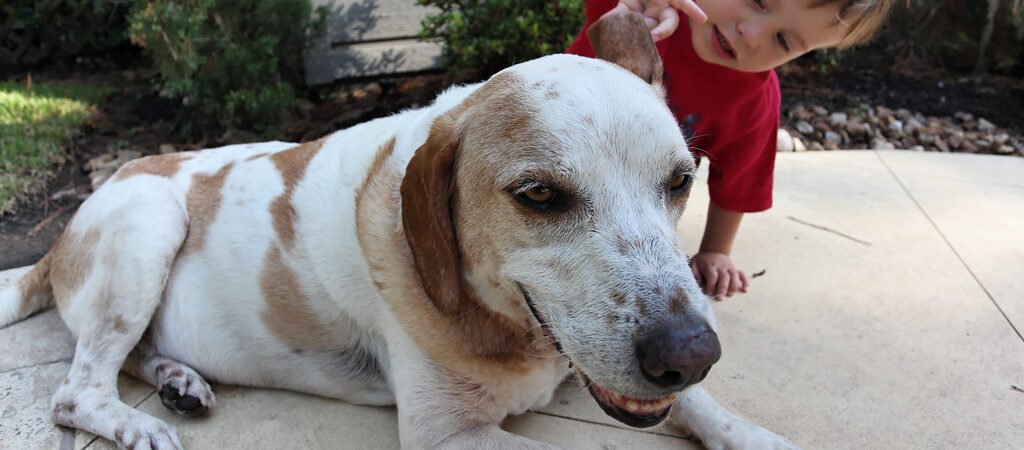
Photo: "Listen to this" by Lars Plougmann, licensed under CC BY-SA 2.0. Source.