Table of Contents
How PawSeniors Researches This
PawSeniors articles are written and edited in-house, then checked against primary veterinary sources before publishing.
- Every medical claim is sourced to the American Kennel Club, PetMD, VCA Animal Hospitals, or another named veterinary source, linked at the end of the article.
- Every claim is tied to a named, checkable veterinary source linked at the end of the article — nothing is published without a reference you can verify yourself.
- Articles are updated when veterinary guidance changes.
A cat straining in the litter box, making frequent trips with little to show for it, or crying out while urinating isn’t being dramatic — it’s showing one of the more common and occasionally urgent problems in cats: feline lower urinary tract disease, or FLUTD.
What Falls Under the FLUTD Umbrella
FLUTD isn’t one disease but a group of conditions that all affect the bladder and urethra, sharing a similar set of symptoms even though the underlying cause differs. The most common form is feline idiopathic cystitis (FIC), bladder inflammation with no identifiable infection, believed to be linked to stress. Bacterial urinary tract infections, bladder stones, and urethral plugs or blockages all fall under the same umbrella, and telling them apart requires diagnostic testing rather than watching symptoms at home.
Signs to Watch For
- Straining to urinate, often with little or no urine actually produced.
- Frequent trips to the litter box, more than the usual pattern for that cat.
- Blood in the urine, sometimes subtle enough to only show as a pink tinge.
- Urinating outside the litter box, especially on cool, smooth surfaces like tile or a bathtub.
- Excessive licking of the genital area, a response to the discomfort.
- Vocalizing or crying out while attempting to urinate.
Why Male Cats Face a Specific Emergency Risk
A male cat’s urethra is narrower than a female’s, which makes male cats far more prone to a complete urethral blockage — a true emergency where a cat can strain repeatedly and pass no urine at all. Left untreated, a blocked cat can develop life-threatening kidney damage or heart complications within 24 to 48 hours. A male cat straining in the box with no urine coming out needs emergency veterinary care immediately, not a wait-and-see night at home.
Why Senior Cats Are Particularly Affected
Stress is a major trigger for the most common form of FLUTD, and senior cats often face more of it than owners realize — a new pet in the house, a move, a change in routine, or even a shift in litter brand can be enough. Senior cats are also more likely to have overlapping conditions, like chronic kidney disease, that complicate both the picture and the treatment plan, and decreased water intake, common as cats age, means more concentrated urine sitting in the bladder longer, adding to irritation.
How It’s Diagnosed
A urinalysis is the starting point for almost every case, checking for blood, crystals, infection, and urine concentration. X-rays or an ultrasound can identify bladder stones that a urinalysis alone would miss, and a urine culture confirms or rules out a bacterial infection before antibiotics are prescribed, rather than treating presumptively.
Managing FLUTD Long-Term
For cats with recurrent FIC, management centers on reducing stress and increasing water intake rather than a single medication: a therapeutic urinary diet, more water sources around the house, a fountain if your cat responds to moving water, and keeping the litter box routine as consistent and low-stress as possible — clean, accessible, and not competed over with another cat in a multi-cat household. Bacterial infections are treated with a specific antibiotic based on culture results, and bladder stones sometimes require a prescription dissolution diet or, less commonly, surgical removal.
The Bottom Line
Straining, frequent litter box trips, or blood in the urine are never symptoms to observe for a few days before acting, especially in a male cat, where the same signs can precede a life-threatening blockage. A same-day vet visit is the right response every time, and the specific cause found during that visit is what actually determines a treatment plan that works.
Sources: PetMD — Feline Lower Urinary Tract Disease (FLUTD), American Veterinary Medical Association — Feline Lower Urinary Tract Disease.
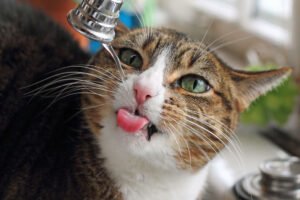
Photo: “Cat unbotheredly drinking water” by Tranhoangnam4320, licensed under CC BY-SA 4.0.