Table of Contents
How PawSeniors Researches This
PawSeniors articles are written and edited in-house, then checked against primary veterinary sources before publishing.
- Every medical claim is sourced to the American Kennel Club, PetMD, VCA Animal Hospitals, or another named veterinary source, linked at the end of the article.
- Every claim is tied to a named, checkable veterinary source linked at the end of the article — nothing is published without a reference you can verify yourself.
- Articles are updated when veterinary guidance changes.
There’s a moment many senior dog owners recognize: your dog wants to come up the stairs, get into the car, or go outside to the yard, but the back legs just aren’t cooperating. Lifting a 30 kg dog by the belly with your bare hands is hard on both of you. A support sling or lifting harness bridges that gap. Used well, it lets a dog keep walking on its own legs, with you supplying the stability the body can no longer provide.
Who Benefits From a Support Sling
Slings and harnesses are most useful for dogs who can still bear weight but need help with balance or strength, including dogs with:
- Arthritis or hip dysplasia that makes rising and climbing difficult
- Hind-end weakness from muscle loss, degenerative myelopathy, or spinal problems such as IVDD
- Recovery from orthopedic or spinal surgery
- Vestibular disease or other conditions affecting balance
- General weakness during illness
MSPCA-Angell describes a sling’s purpose as helping to stabilize and support hind-end mobility in a pet with weakness or one healing from surgery. Before relying on one long term, have your vet assess why your dog is weak. Some causes are treatable, and a rehabilitation vet can advise on the right kind of support.
The Main Types
Rear Support Slings
A padded band that wraps under the belly just in front of the hind legs, with long handles you hold from above. They’re simple, inexpensive, and quick to put on, which makes them ideal for short tasks like stairs, getting into the car, or bathroom trips. They’re also the easiest to improvise in an emergency.
Rear Leg Harnesses
These have leg loops that fit around each hind leg and a handle over the hips. They stay in place better than a simple sling and suit dogs who need hind-end support for longer walks.
Full-Body Lifting Harnesses
These combine a chest section and a rear section, each with its own handle, and are often designed to be worn for much of the day. They’re the best choice for dogs who are weak at both ends, very large dogs, or dogs who need frequent help getting up. Look for breathable padding and a design that allows a male dog to urinate without soiling the harness.
A Quick DIY Option
If you need support today, MSPCA-Angell suggests making a sling from a sturdy reusable grocery tote: cut down the middle of both sides, flatten it, and slip it under the dog’s lower belly while holding the handles. A long bath towel folded lengthwise works similarly. These are great stopgaps while you choose a purpose-made product.
How to Use One Safely
- Support, don’t hoist. The goal is to take some of the weight, not lift the dog off the ground. Let your dog walk and use its own legs as much as it can.
- Position it correctly. A rear sling should sit under the belly just in front of the back legs, not over the ribs or too close to the genitals.
- Lift with your legs. Bend your knees and keep your back straight, especially with large dogs. Shorten the handles if you’re stooping.
- Move at your dog’s pace. Go slowly on stairs and slick floors, and give your dog a moment to find its footing before each step.
- Check the skin. Look for redness, rubbing, or matted fur where straps sit, particularly with harnesses worn for long periods. Take them off for rest and sleep unless your vet suggests otherwise.
- Keep it clean and dry. Urine or moisture trapped against the skin can cause irritation and sores.
Getting the Right Fit
Measure your dog around the widest part of the chest and around the belly in front of the hind legs, and check the brand’s sizing chart rather than relying on weight alone. A good fit is snug enough that the harness doesn’t slip or twist, but loose enough that you can slide two fingers under each strap. Introduce it gradually with treats so your dog associates it with good things before you need it in a hurry.
The Bottom Line
A support sling or lifting harness is one of the simplest tools for keeping a weak senior dog mobile, safe on stairs, and able to join family outings. Choose the type that matches how much help your dog needs, use it to support rather than carry, and pair it with your vet’s plan for whatever is causing the weakness.
Sources: MSPCA-Angell — How to Make a Supportive Dog Sling.
Related reading: Why Are My Old Dog’s Back Legs Shaking? Causes and When to Worry
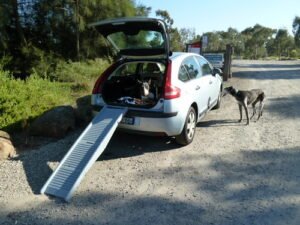
Photo: “Walking With An Old Dog” by Helgi Halldórsson, licensed under CC BY-SA 2.0.